2021 was the 13th year of the Middleton Island Tree Swallow (TRES) project. The season started off with an inspection of the nest boxes by ISRC-members in April. Five new nest boxes were installed, replacing ones that had rotted away. Thanks to their efforts in 2021 17 boxes were available to the swallows:
Swallow boxes check, conducted by ISRC personnel on April 19, 2021:
Box 1: Good shape, slightly rotten but sturdy. Might need to replace in 2022/2023
Box 2: No more door present, wood very rotten. Needs to be replaced
Box 3: Good shape!
Box 4: Good shape!
Box 5: Old box fell off and was no reparable. Replaced by new box (green one) in exact same location/orientation.
Box 6: Old box replaced by new one (white one) in the exact same location.
Box 7: Good shape!
Box 8: Ok condition, should last through another season but would need to be replaced in 2022.
Box 9: Old box replaced by new one (white one). Exact same location as previous box.
Box 10: Broken (bottom and side panels missing). Needs to be replaced.
Box 11: Replaced with new box (white one). Box on the angled post facing down and angle adjusted using washer to avoid having the box too tilted forward. New box slightly lower than old one as per recommendation.
Box 12: Good condition, slightly rotten but sturdy. Consider changing in 2022/2023
Box 13: Good condition, back corner rotten but box feels sturdy. Nail for the door missing.
Box 14: Box completely broken and rotten. Replaced by new box (green one).
Box 15: Good condition, starting to rot a little bit.
Box 16: No box. Needs new one.
Box 17: Perfect condition!
Box 18: Perfect condition!
Box 19: Good condition. Post slightly angled
Box 20: Unknown
Unfortunately, due to a lack of time the 2021 ISRC-crew did not manage to monitor the TRES during the breeding season, nor conduct a post-breeding season nest box inspection. The following inspection round could only take place in April 2022, during the start of the following ISRC-season. Details on the 2021 TRES-breeding season were derived from what was found in the nest boxes during this inspection:
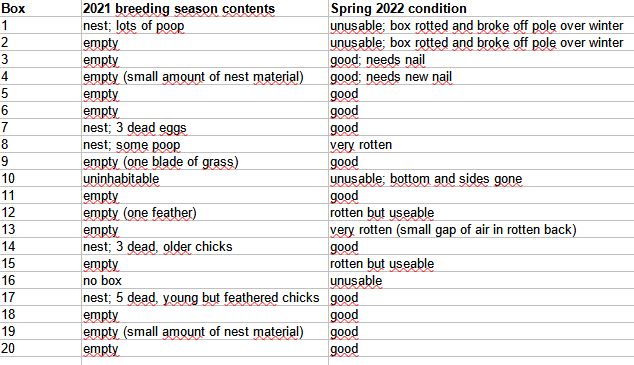
From this information it can be concluded that in 2021 five TRES-pairs nested in Middleton Island's nest box project.

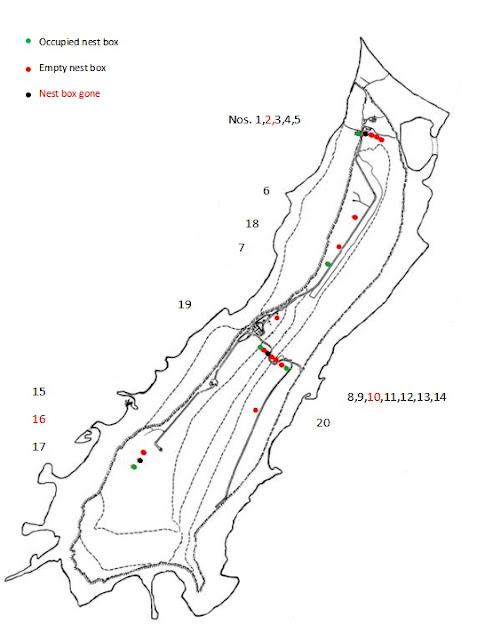
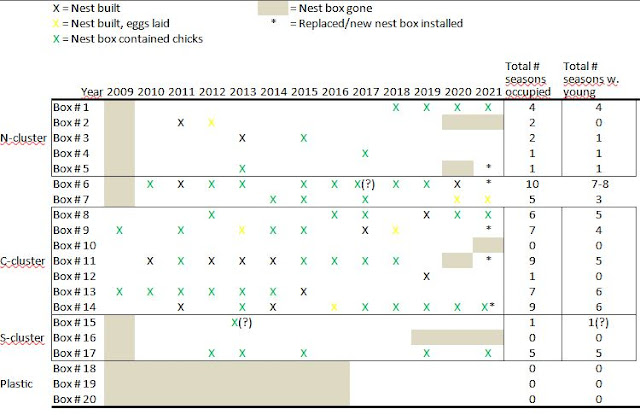
Notes on the 2021 breeding season (and looking ahead)
As for potential predators, a Peregrine Falcon was recorded on several occasions in spring, in April until May 11th, but not during the period the TRES were nesting on the island (data: ebird.org). The relative large number of dead eggs and chicks found in the nests may be the result of a long period of bad weather taking place at some point in June/early July.
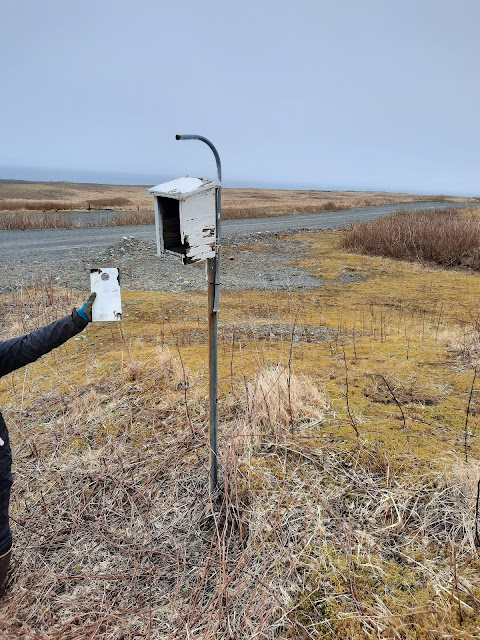
Several of the nest boxes currently present on the island have been out in Middleton's harsh climate for 12 or 13 years now and underwent only a serious renovation (= complete checkup + new layers of paint) in 2016. It's inevitable that they will continue to decay and more and more boxes will be lost. To take care of this problem a number of boxes installed from 2016 onwards are (partially) made from recycled plastic or PVC:
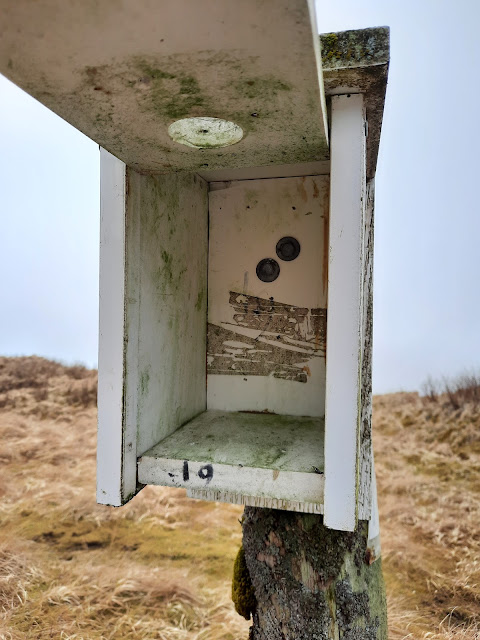
Boxes # 18, 19 and 20 are made from white PVC-planks and were installed by the end of the 2016 summer. These have thus far never been used by the swallows (except for an occasional piece of nest material).
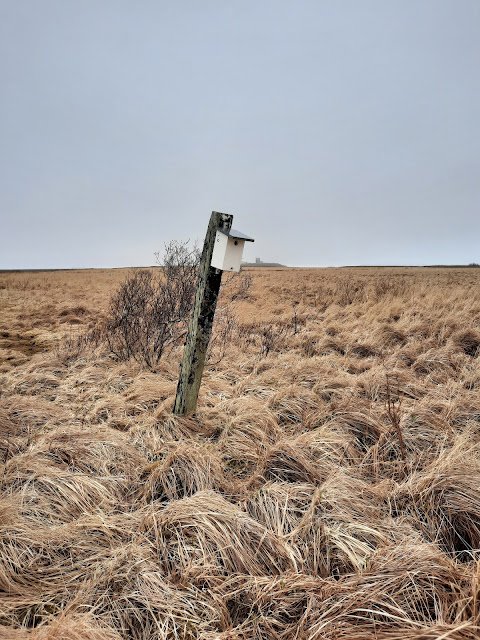
In spring 2021, 3 boxes were installed to replace some of the most popular, but damaged ones (#'s 6, 9 and 11). These new boxes are made from wood and are similar in size to the remaining types constructed for the project, while adding a (recycled) plastic (dark colored) roof and an aluminum mounting bar. In their first year these did not get used, although a single piece of nest material was brought into box #9.
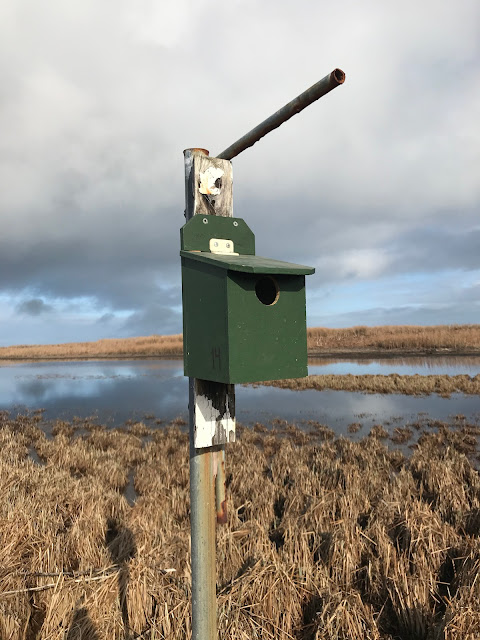
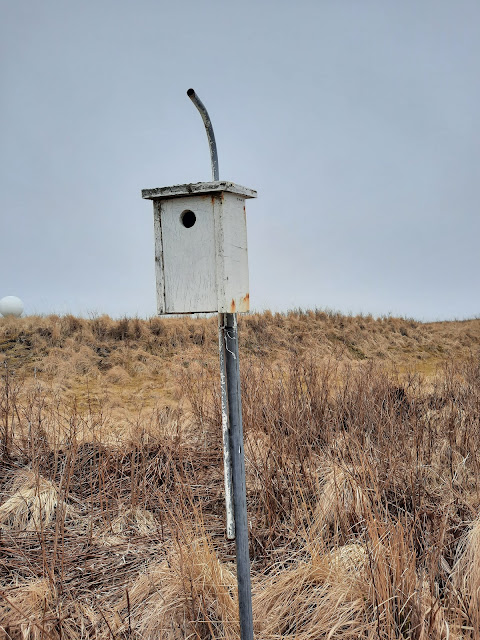
Two of the new boxes that were installed in spring 2021 (to replace #'s 5 and 14), were made entirely from recycled plastic panels. These boxes are green and have much smaller dimensions than a regular TRES nest box. They were already brought to the island in 2016, but were at that time deemed too small for the TRES to use (and too fragile to remain there in winter). These European nest boxes are designed for house sparrows, but have a slightly enlarged entrance. Surprisingly, in 2021 box 14 (the one on the photo above) was used by the TRES! It contained a nest with 3 dead chicks...
With the ongoing decay of the wooden nest boxes in the project, in 2022 the TRES will find a relatively larger number of synthetic nest sites available to them. We will hopefully soon find out whether the TRES are willing to adapt to these boxes, so the amount of maintenance can be reduced significantly.
I thank the 2021 & 2022 ISRC-crew members for their help!